6 mins read
Increasing conversion and retention after that
Disclaimer : This article evaluates a fictional, conceptual product created strictly to analyze user retention mechanics and churn vulnerabilities. All critiques, feature suggestions, and workflow breakdowns apply exclusively to this conceptual model. This analysis does not reflect, critique, or represent the actual internal architecture, business practices, or operations of any real-world platform.
Consider the subscription flow of an article reading app
Skipping the standard payment related screens because that particular part is irrelevant for this article.
Target business metrics :
Increase LTV
Reduce Churn
Increase Cohort Retention
Increase Conversion

Breaking it down

The user is shown a part of the article and the rest of it gets hidden under a blurry curtain. The user can read the entire article only if they become a member of the platform.
This is scarcity effect in action. Very common in business world to urge people to make a purchase. ‘Only 3 left in the stock’, ‘Limited time offer’, ‘Only 1 spot left’, etc. all are examples of scarcity effect. When you do not get enough of something, it is scarcity effect. In this case, it is dangled in front of the user’s eyes that the full article exists but they cannot read it yet, unless they become a member.
It is powerful, especially when the scarcity is genuine (people can sense it subconsciously). This is good for converting non paid users to paid users. That is because scarcity drives immediate action. People do not always buy something just because they like it. They need the urge to buy it, else they will get distracted and forget to buy or procrastinate. This kind of mechanics will increase the probability of converting more number of users to paid customers. Hence, increasing the Conversion Rate.

Though this kind of scarcity is quite effective in such cases, but the above transition feels very ‘businessy’ / ‘salesy’ / transactional. It does not feel very personal for the user.
The goal is to increase LTV. So, this kind of transition will increase LTV only if the business can handle considerable discount in yearly subscription for the platform, so that users are more interested in subscribing for a year, increasing retention and LTV as a result.
But this kind of transition feels very ‘businessy’, the user may feel tricked or manipulated and as a result majority of the times not feel good about their purchase (buyer’s remorse). In such cases, the user will opt out of the experience as soon as they can. Added to that, in business world it is bound to happen that other businesses will enter the market and provide better values, as a result it becomes easier for users to opt out of their current experience, increasing Churn.
So, to reduce churn and convert users to loyal followers (and LTV as a result, since, more recurring revenue generated from longer retained customers), we need to make it feel more personal for them.
Scenario 1

We need to make sure the user feels they made a smart decision by subscribing, to avoid buyer’s remorse. So, showing them and mentioning it explicitly how much more content they now get, just because of a purchasing decision, opens up various opportunities for them to get even smarter and more competent in their area of interests. This feels like a smart spending decision (or smart investment, as sometimes people tend to refer).
Added to that if we can explicitly mention about their favorites or most visited interest areas, it adds a layer of personalization as well. In the above images, most read topic ‘Psychology’ or most read writer ‘John Doe’ are such examples. More the personalization, more they feel the product is specifically for them. This surprises them that the product or the company cares for their choices. This leads to another kind of psychological phenomenon called ‘IKEA effect’ which makes them reluctant to leave the platform. Think of various algorithms which auto customizes itself based on your area of interests. Reducing churn.
A mini delight factor

To bring the focus of the users towards the newly unlockable items we can keep them inside 3 locked buttons. This kind of interactive design can add further delight to the experience for the users.
But this concept of unlocking new readable articles works for users who are using the platform to learn about things, curious about learning more and want to get more competent with passing days. What if the business has a secondary target market of users, who engage with / read the articles for the sake of indulgence with art and beauty presented by the artists / writers?
Scenario 2

In case the product is targeted towards a secondary market, consisting of people who prefer indulging in writings as art, we can explicitly show how their purchasing decisions are affecting the creators of those work of arts. This again feels very personal and a decent purchasing decision, indicating ‘I have contributed for a good thing in the society as a human being’.
Scenario 3
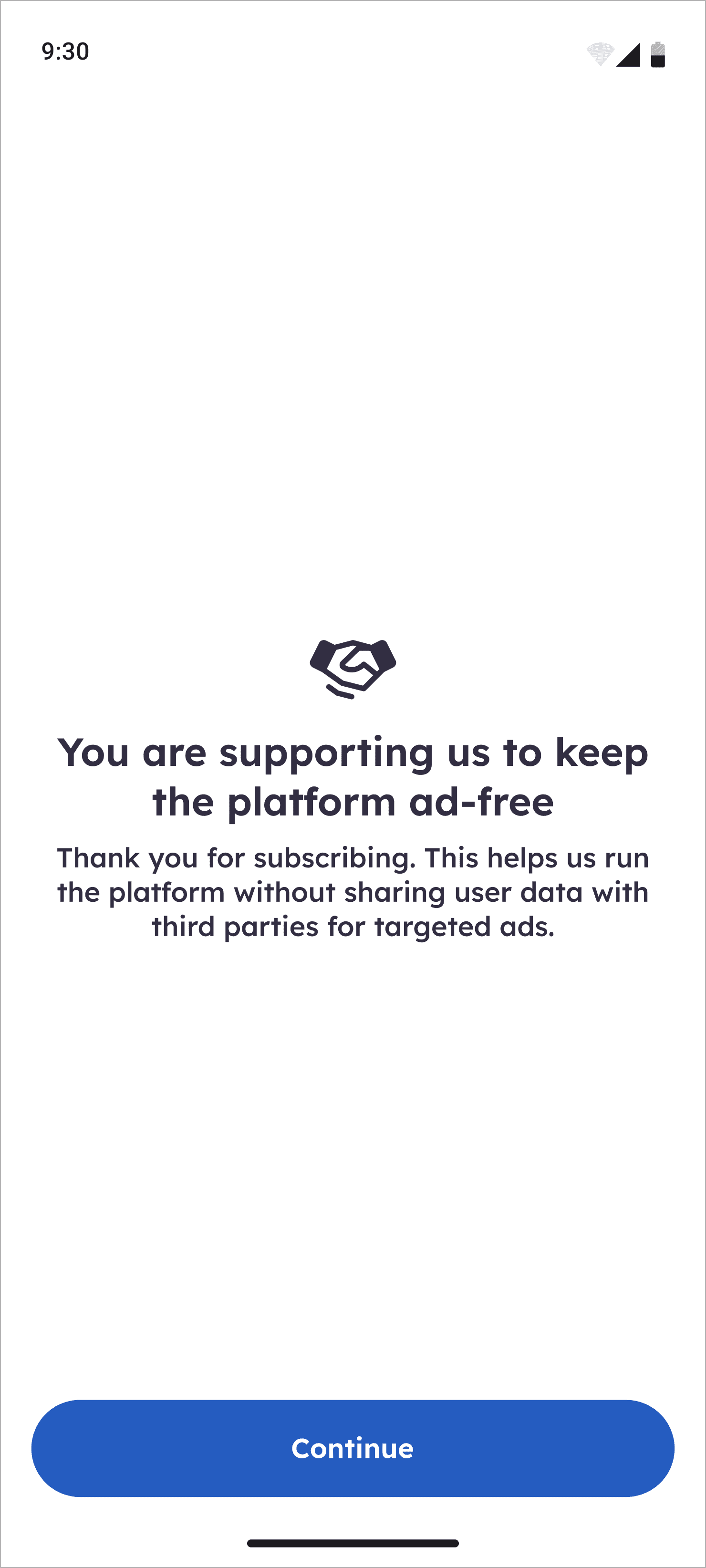
What if the target market consists of users who hate ads, get irritated by them or fight against targeted ads for data selling?
In that case we can explicitly mention immediately after their purchasing decision, how their contribution is supporting the platform fight for similar cause. This is especially powerful when the brand strongly stands for privacy. This not only makes the user feel their purchasing decision was smart but also good for brand recognition in their minds.
Scenario 4

Human beings have a strong desire to belong somewhere. We have evolved to belong, we survive better that way. We want to get accepted by someone or a community.
So, in case the target market of users care about belonging to a group where people are curious beings and discuss about their curiosities openly, we can show they have joined such a group, immediately after they subscribe. This does not feel like a purchase made to just read articles (which is important, FYI, since it is the primary utility of the app) but it feels like they have become a part of something.
It also makes them justify their purchasing decision - since so many other people have made similar decision, it must be a smart choice otherwise so many others wouldn’t have done it in the first place. We have evolved to imitate other human beings as well, it increases belongingness and also it has kept our ancestors safe as per the jungle diaries.
The above mentioned features and mechanics make the user feel good about their purchasing decision by giving them an immediate positive feedback just after payment completion.
This relates to a concept called Peak - End Rule. It is a mental shortcut where people judge an experience based mostly on how they felt at its most intense point (the peak) and how it finished (the end), rather than on the total sum or average of every moment.
This ensures that they do not churn, keep subscribing for a longer period of time, since they feel smart about their spending decision, increasing LTV as a result. The type of positive feedback will vary based on the target users and the psychography.
How can we help you?
Product builders need to keep few things in mind :
Conversion urgency : People do not just buy a product because they like it. There needs to be an urgency for them to make an expense. Scarcity effect is not the only way to create urgency among the users. There are various ways of implementing urgency, we can even get creative about it. But it depends on target user's psychography which urgency will work best for the given product. Random urgency is going to make the user churn right at the moment when they hit the paywall.
After experiencing urgency : There is a very high probability that if users do not get any feedback immediately after making an expense - an expense made because of urgency - they are not going to feel very good about their decision. And people always remember how the product made them feel. And our brain takes a shortcut and associates that feeling with the product. Inappropriate feeling translates to 'Worst product in the market' or 'Not for me product' in the user's mind. Appropriate feeling translates to 'Decent product in the market, at least worth the expense'. But what is inappropriate or appropriate feeling for the user depends entirely on their psychography. Inappropriate and random feeling is going to make the user switch to competitor's product (churn) or indulge in other products as soon as they find a window of opportunity to do so. In case of subscription model, users are more likely to stop their subscription renewal (churn on the date of renewal) as soon as they can in such case.
Our expertise : We use Behavioral Science to understand target user's psychography. Then craft the most appropriate urgency during the conversion, increasing conversion as a result instead of churning. And then figure out providing what will make them feel great about their purchasing decision and implementing appropriate features and mechanics accordingly, so that they stick with the product for longer.
Conclusion
Bottom line being, depending on the target users’ psychology, we can modify the features and mechanics of a product to give them a well thought out feeling through an experience. A thoughtfully crafted experience that drives certain behaviors from the users - the behaviors which affect the target business metrics, in this case it is churn, retention, conversion and LTV.
These things act in a very subtle way, affecting the subconscious mind. And the interesting part is, it is even difficult for us humans to articulate these feelings and experiences affecting our mind through words because majorly language is not handled by the same part of our brains.
This is just one subscription flow of a product. There can be hundreds of features and mechanics all working together in a product to reach the desired business goals.
Just crafting the subscription flow is not enough to reduce Churn. In the other article, I show how crafting features and mechanics thoughtfully as per users’ psychology, can make them engage with the app regularly / frequently, increasing DAU / MAU and eventually making it a habit forming product. And habit forming products usually have low churn rate, people stick with the product for a long time, increasing recurring revenue from each paying customer.
© 2026 PICOTEE LOOP. All rights reserved.
Disclaimers : The results, claims, advice, and articles shared on this website are for illustrative purposes only and do not guarantee identical outcomes for every client. Individual results may vary depending on execution, product quality, market conditions, industry and audience behavior.
All product names, logos, brands, and trademarks displayed in our articles belong to their respective owners. Their use does not imply any affiliation with, endorsement by, or sponsorship from the trademark holders.
Best viewed on a desktop screen
Want to reduce your product's churn rate? We’ve built a detailed experience best viewed on a wider display (864px+).
We want our clients to make informed decision. So, to continue :
Switch to a desktop or tablet.
Or tap your browser settings and check 'Desktop site'.
PICOTEE LOOP
In case you have visited our page before, you can just